
Canadian Diocese
.avif)
%20%232.avif)
%20%233.avif)
The Origins of the Canadian Armenian Community
Armenians first arrived in Canada in the late 1800s, with immigration increasing after the Genocide of 1915. Early settlers built communities across Ontario and beyond, strengthened by the arrival of Armenian orphans in the 1920s. Today, over 80,000 Armenians live across Canada.

Four Early Communities
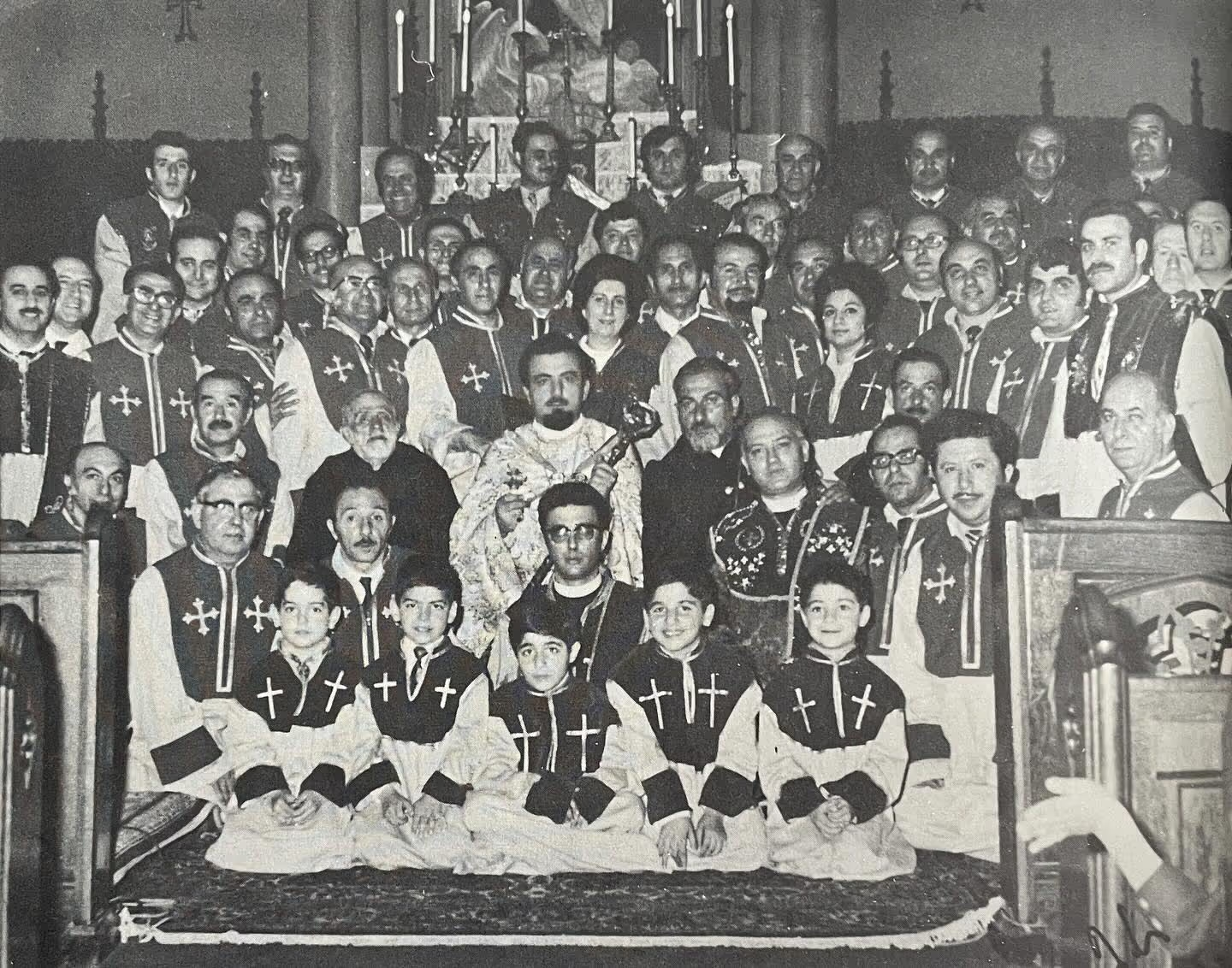
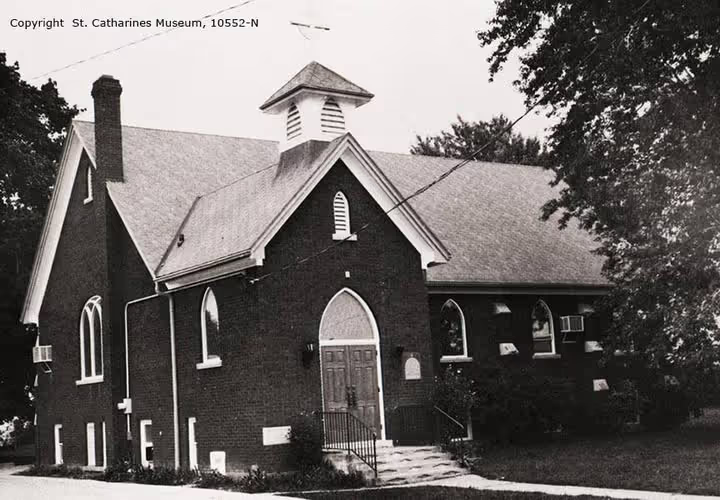
Early Armenian communities emerged in St. Catharines, Toronto, Hamilton, and Montreal, where settlers organized language classes, social groups, and worship services. Their efforts formed the first foundations of Armenian parish life in Canada.
Establishing the Canadian Vicariate
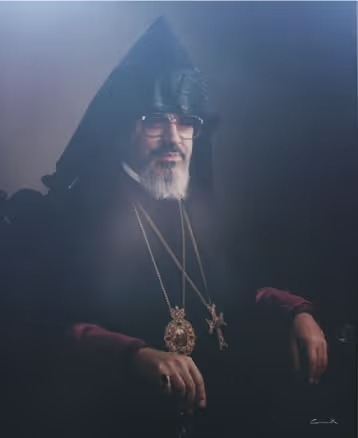
Canada clearly required a more permanent pastor, one who-if not dedicated exclusively to the country-could at least devote a substantial amount of his time to the sprawling Montreal community. Such a request was presented to the diocesan primate in New York, and it was fulfilled at last on November 7, 1966, when Bishop Torkom Manoogian appointed Fr. Vazken Tatoyan to the post. In June of the following year, Bishop Manoogian established the regional vicarate of Canada under the jurisdiction of the diocese, and Fr. Vatche Hovsepian was dispatched to Montreal to be its first occupant. He was consecrated as a bishop by His Holiness Vasken I in October of 1967, and continued in his role until 1971. He was succeeded by Fr. Zaven Arzoumanian (1971-1973), Fr. Shnork Kasparian (1974), Bishop Aris Shirvanian (1974-1978) and Fr. Vazken Keshishian (1979-1983). Needless to say, the Canadian Vicarate, like the diocese itself, functioned under the authority of the Mother See of Holy Etchmiadzin. However, the schism in the American diocese which began in New York in 1933 has affected the community in Canada as well, and several parishes affiliated with the Cilician Catholicate have been established in the country.

A Diocese for Canada
The possibility of creating a distinct Armenian Church diocese for Canada was a matter of discussion for some time. But it was only in the early 1970s that the first steps were taken to extract the Canadian churches from their parent jurisdiction, the Eastern Diocese of America, headquartered in New York City. From 1970 through 1975, Archbishop Torkom Manoogian held consultations with the parish councils of the churches of Montreal, Toronto and St. Catharines.
A set of bylaws was drawn up in 1977 and submitted to the primate and the Diocesan Council for the proposed Canadian diocese. A copy was forwarded to Catholicos Vasken I at Holy Etchmiadzin, and the reaction of the Supreme Spiritual Council was positive. The establishment of a Canadian diocese is only a matter of time,” it decreed, and should be realized no later than six months after the issuance of this letter.” This objective would take somewhat longer to realize, however. In February of 1980, a letter containing recommendations from the primate and the Diocesan Council was addressed to His Holiness for approval and ratification. It proposed the establishment of a fully operational Canadian diocese by 1983. With the consent of the Catholicos, a committee would be created under the presidency of the vicar of Canada whose membership would include the pastors, parish council chairmen and delegates from the seven Canadian parishes. This committee would review the bylaws drafted in 1977; pursue the organization of choirs, youth committees and women’s guilds within each of the parishes; and recommend the location for the seat of the future primate of Canada. In an encyclical dated November 15, 1980, His Holiness Vasken I officially authorized the creation of the Diocese of the Armenian Church of Canada, thus setting in motion a series of rapid developments. In February 1981, the guidelines for the Canadian diocese were considered and approved by the representatives of the parishes. In November 1982, the Catholicos gave his consent to the bylaws. On September 3, 1983, the first Diocesan Assembly of the Canadian diocese was convened at Toronto’s Holy Trinity Church. Archbishop Manoogian presided over the meeting of thirty-two delegates representing the seven Canadian parishes. The encyclical of His Holiness Vasken I was read, officially announcing the establishment of the Canadian diocese, whose offices would henceforth be located at the St. Gregory the Illuminator Cathedral in Montreal, and which would now enjoy the direct spiritual administration of the Mother See. Archbishop Manoogian announced that a Locum Tenens, Fr. Vazken Keshishian, would assume his duties as of November 1, 1983.
The following year, Fr. Keshishian was ordained as a bishop by the catholicos at Holy Etchmiadzin. Finally, on October 6, 1984, the Diocesan Assembly convening at the St. Gregory the Illuminator Church of St. Catharines elected Bishop Vazken Keshishian as the first primate of Canada. Bishop Keshishian was granted the rank of ” archbishop ” in 1988, and he continued in office until March of 1990. At that time, sadly, the primate passed away.
The Rise of a Flourishing Diocese
Fr. Hovnan Derderian took over the leadership of the diocese as Locum Tenens, and in May of 1990, he succeeded Archbishop Keshishian as Primate. Subsequently raised to the rank of bishop and, later, archbishop, the young and dynamic Archbishop Derderian was re-elected to the primacy in 1995 and serves in that capacity to the present day. With the creation of a distinct jurisdiction for their Church, the Armenians of Canada were inspired to build their community with renewed vigor and optimism. Older parishes flourished, and new ones rapidly formed. There was a flowering of social and cultural activities, and weekday, Saturday and Sunday schools began to function in most parishes. Presently, the diocese supervises nine parishes across the country: the St. Gregory the Illuminator Cathedral of Montreal, Holy Trinity of Toronto, St. Gregory the Illuminator of St. Catharines, St. Mary of Hamilton, St. Vartan of Vancouver, St. Mesrob of Ottawa, St. Vartan of Mississauga, Holy Resurrection of Windsor and Holy Cross of Laval.